Blue Valley North Boys Basketball

2020-2021 6A State Champions
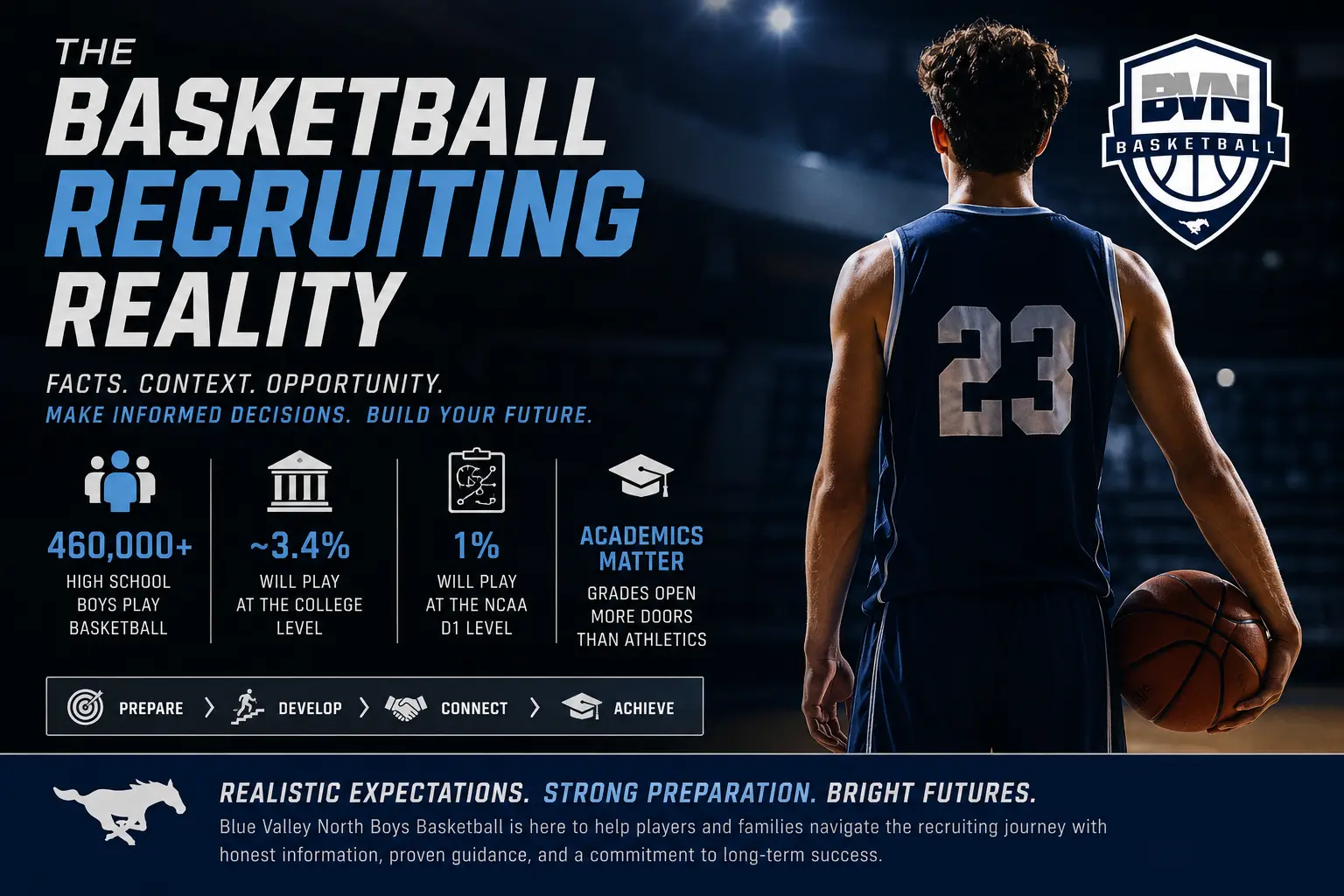
Blue Valley North Basketball Recruiting Reality

Basketball Recruiting Reality Guide

Quick reality check: college basketball recruiting is not just about being good. It is about whether a college staff can clearly see a player fitting a specific roster need, academic profile, financial situation, competitive level, and timeline.

The biggest recruiting mistake families make is treating recruiting like a popularity contest: more camps, more posts, more highlight clips, more vague exposure. The real process is narrower and colder than that. A coach is not asking, “Is this player good?” The coach is asking, “Can this player help us win, fit our budget, fit our admissions standards, fit our roster, and still be available when we need him?”

This guide is built for families who want the truth before they spend thousands of dollars chasing the wrong signals.

What This Guide Does Differently

Most recruiting articles tell players to email coaches, make a highlight video, attend camps, and keep working hard. That advice is not wrong, but it is incomplete. It skips the real questions families face.

  • Why does one player get interest while another similar player gets ignored?
  • When is an “invite” real recruiting and when is it just a camp marketing list?
  • How do you know if a player is chasing the wrong level?
  • What should a family do when junior year arrives and there are no offers?
  • How much money can recruiting quietly cost before anything real happens?
  • What do college coaches see in film that families miss?

This page answers those questions from a practical high school program perspective. It is written for families trying to make smart decisions, not for recruiting companies trying to sell exposure.

The Recruiting Funnel Families Rarely See

Families often use the word “recruited” too early. A player may receive camp mail, social media follows, questionnaire links, showcase invitations, or a short message from a coach. Those things can matter, but they are not all equal.

SignalWhat Families Often Think It MeansWhat It May Actually MeanWhat To Do Next
Camp invite emailThe school is recruiting me.Could be mass marketing unless it includes specific personal evaluation or direct coach context.Ask whether the staff has watched your film and where you fit in their recruiting board.
Coach follows on social mediaThe coach is seriously interested.Could be light monitoring, early awareness, or simply a way to track many players.Send a short message with film, graduation year, position, height, GPA, and schedule.
Questionnaire requestI am on their recruiting list.You are in their database. That is a starting point, not a commitment.Complete it, then follow up with film and schedule.
Personal text or callThis is serious.It is more meaningful, but still depends on frequency, role discussion, and evaluation depth.Ask what they like, what they need to see next, and where you stand positionally.
Unofficial visit inviteAn offer may be coming.Could be serious, exploratory, or part of a broader group visit strategy.Prepare questions about roster needs, academics, cost, and next steps.

The recruiting test: if a college coach cannot explain the player’s projected role, position fit, academic fit, and next step, the family should treat the contact as interest, not recruitment.

The BVN Recruiting Reality Scorecard

This scorecard helps families see where they actually are. It is not a guarantee. It is a reality filter.

CategoryGreen SignalYellow SignalRed Signal
FilmShort highlight film plus full-game film showing role, decision-making, defense, and pace.Highlight film exists but does not show defense, misses, passing, physicality, or game context.No current film or only social media clips.
AcademicsGPA, test plan, transcript awareness, and admissions fit are clear.Grades are okay, but not connected to target schools.No academic target list.
Level FitTarget list includes multiple levels and realistic roster comparisons.Family says “D1 or nothing” without roster comparison.Target list is based on logos instead of fit.
CommunicationPlayer sends clear emails with film, schedule, academics, and coach contact.Parent is doing most communication.No direct outreach or only generic mass emails.
Financial ClarityFamily understands athletic aid, academic aid, need-based aid, and total cost.Family assumes “recruited” means “paid for.”No cost discussion until after emotional commitment.

Strong recruiting position: a player has current film, full-game proof, academic clarity, realistic level targets, player-led communication, and coaches who can describe a potential role.

Weak recruiting position: a player is waiting to be discovered, has no full-game film, only attends exposure events, has no academic plan, and targets schools based on logos rather than roster fit.

The Level Fit Reality

Families often ask the wrong question: “Can he play college basketball?” A better question is: “At what level would a coach see him as valuable enough to recruit, admit, support, or roster?”

Dream Level

The school level the player wants emotionally, often shaped by TV, brand names, friends, and social media.

Evaluation Level

The level where coaches respond after watching film, seeing games, and comparing the player to roster needs.

Best-Fit Level

The level where the player can develop, contribute, afford school, handle academics, and enjoy the experience.

LevelReality Families Should UnderstandSmart Family Question
Division IExtremely competitive, narrow roster needs, and transfers have changed freshman evaluation.What makes this player clearly different from other prospects at the same position?
Division IIHighly competitive, often with partial scholarship realities and strong regional recruiting.Does the player’s game translate physically and skill-wise to this level right now?
Division IIINo athletic scholarships, but strong academic and basketball fit can be excellent.Would this school still be a good choice if basketball ended sophomore year?
NAIAStrong opportunities and aid combinations, but total cost matters.What is the complete financial package after athletic, academic, and other aid?
JUCOA development, academic, exposure, or reset path that requires maturity and a plan.Is this a bridge to a better fit or just a panic option?
Walk-OnCan be meaningful, but families must understand role, cost, roster security, and daily expectations.Is this player wanted as a real developmental piece or simply allowed to try?

A family should never treat a lower level as failure. The wrong level can bury a player. The right level can give him a real role, confidence, academic momentum, and a great college experience.

Coach Communication Reality

College coaches are busy. A long emotional email is not as useful as a short message that gives them everything they need in 20 seconds.

Player Email Framework

Coach [Last Name],

My name is [Player Name], a [graduation year] guard/forward at Blue Valley North High School in Overland Park, Kansas. I am [height], [GPA], and I am interested in [school name] because [specific academic/basketball reason].

Here is my current film: [link]. Here is our schedule: [link]. My high school coach is [coach name/contact]. I would appreciate any feedback on whether I fit what your program is looking for in my class.

Thank you,
[Player Name]

The key is specificity. A coach should not have to hunt for graduation year, school, position, height, film, schedule, grades, or coach contact.

Recruiting reality: coaches recruit players, not parents. Parents can organize, advise, and ask financial questions, but the player should learn to communicate for himself.

Film That Gets Watched

A highlight tape should not try to prove that a player once made shots. It should help a coach decide whether to keep evaluating. The first 30 seconds matter. The first possession matters. Coaches want translation, not decoration.

Film ElementWhat Coaches Can LearnCommon Family Mistake
First 5 clipsBest skill, athleticism, role, and position fit.Opening with average layups, slow intros, graphics, or celebrations.
Defensive clipsFootwork, toughness, awareness, communication, and physical tools.Only showing made shots.
Passing clipsDecision-making, pace, vision, and ability to play with good players.Showing only scoring when the college role may be connector or defender.
Full-game filmConsistency, body language, mistakes, conditioning, spacing, and shot selection.Hiding full-game film because the highlight tape looks better.

The 7-Clip Test

If a college coach only watches seven clips, what does the player prove? A strong sequence should answer at least four of these:

  • Can he shoot at college speed?
  • Can he defend someone college coaches care about?
  • Can he pass before the help fully commits?
  • Can he finish through contact or length?
  • Can he move without the ball?
  • Can he make the simple winning play?
  • Does his body, pace, and decision-making match the level he is targeting?

Strong film is not just exciting. Strong film is efficient. It shows the player’s college role quickly.

The Hidden Cost Of Recruiting

Families can spend a lot before any school becomes serious. That does not mean camps, showcases, travel, or film services are bad. It means every expense should have a purpose.

ExpenseGood Reason To SpendBad Reason To Spend
College elite campThe school has watched film, fits academically, and wants to evaluate the player directly.The family hopes the camp alone will create interest from nothing.
ShowcaseVerified coaches attend, the player fits the audience, and film will be usable.The event promises exposure but does not identify who will evaluate.
Recruiting serviceThe service provides real organization and honest evaluation.The service sells hope, rankings, or generic email blasts.
Film productionThe film is clear, current, concise, and organized around role fit.The video is overproduced but does not show basketball translation.

Family budget rule: before paying for a recruiting event, ask: “Which specific schools or levels could this event realistically move us closer to?” If there is no answer, slow down.

The Parent Role

Parents help with transportation, cost, academics, organization, emotional balance, and big decisions. But when parents become the voice of the process, coaches notice.

Parent Job

Help organize schools, travel, finances, academic requirements, forms, and calendar reminders.

Player Job

Email coaches, answer questions, send film, ask about fit, and show maturity.

Coach Job

Evaluate honestly, support the player when appropriate, and provide context when asked.

Parent Questions That Help

  • What is the full cost after all aid?
  • What academic support exists?
  • How safe is the roster spot?
  • What happens if the coaching staff changes?
  • Would this school still make sense without basketball?

Parent Behaviors That Hurt

  • Arguing with coaches about evaluation.
  • Sending long emotional emails on behalf of the player.
  • Explaining away every weakness.
  • Treating every camp invite as proof of recruitment.
  • Ignoring academic or financial fit because the logo feels exciting.

Questions Families Should Ask College Coaches

The best questions are not always about facilities, gear, or playing time. They reveal how the program actually works.

QuestionWhy It Matters
Where do you see me fitting on your roster?Forces the coach to describe a real role, not vague interest.
How many players at my position are already on the roster?Reveals depth-chart reality.
How many players in your program have transferred recently?Helps families understand roster stability and culture.
What would I need to improve before arriving?Shows whether the staff has evaluated honestly.
Is this an athletic scholarship, academic package, need-based package, or walk-on opportunity?Prevents financial misunderstanding.
What is the next step after this conversation?Serious recruiting should have a next step.

Simple truth: if a coach cannot answer specific questions, the family should be careful about making emotional decisions.

Recruiting Red Flags

Not every opportunity is equal. Some are excellent. Some are unclear. Some are expensive distractions.

Red flag: a camp or event says a player is “on the radar” but no coach has watched real film, discussed position fit, or identified what they need to see.

Red flag: a program talks about opportunity but avoids clear financial details until late in the process.

Red flag: a family is told the player is a priority, but communication only happens when another paid event is coming up.

Red flag: the player is chasing schools that never respond while ignoring schools that are actively communicating.

Green Flags

  • The coach has watched full-game film and can discuss specifics.
  • The coach explains role and roster fit clearly.
  • The school fits academically and financially.
  • The player communicates directly and professionally.
  • The family understands the difference between interest, offer, admission, and financial package.

The No-Offer Reality

Having no offers by junior year does not automatically mean the player cannot play in college. It does mean the family needs to move from hope to structure.

SituationWhat It Usually MeansBest Next Move
No offers, no coach contactThe player is not visible enough, not targeted properly, or not matching the levels being contacted.Create film, build a realistic list, and contact schools across multiple levels.
Lots of camp invites, no personal feedbackLikely broad marketing or early awareness, not active recruitment.Ask direct questions before spending more money.
Some D3/NAIA interest, family wants D1The market is giving feedback that the family may not want to hear.Compare the player to current rosters honestly.
Senior year interest appears lateSome programs still fill needs late, especially after roster changes.Move quickly with film, transcript, coach contact, and visit questions.

The worst response to no offers is panic spending. The best response is targeted action.

Recruiting Reality Checklist

Player Checklist

  • I have a current highlight film under 3 minutes.
  • I have at least one full-game film link ready.
  • I know my GPA and academic profile.
  • I can explain what kind of player I am in one sentence.
  • I have a realistic school list across multiple levels.
  • I have emailed coaches myself.
  • I know my upcoming game schedule and can send it quickly.

Family Checklist

  • We understand that exposure is not recruitment.
  • We have discussed total college cost, not just athletic opportunity.
  • We know the difference between camp invite, interest, offer, admission, and financial package.
  • We are asking direct questions before paying for events.
  • We are considering happiness, development, academics, and role, not only the logo.

Final Recruiting Truth

The best recruiting outcome is not always the biggest logo. The best outcome is the school where the player can grow, compete, study, afford the experience, trust the staff, and still be proud of the decision when basketball gets difficult.

Recruiting is not a straight line. It is a series of decisions. Make each one with clear eyes.

Related Recruiting Guides Coming Soon

No Offers Junior Year

What families should do when junior year arrives without serious recruiting traction.

Walk-On Reality

Preferred walk-ons, true walk-ons, cost, role, roster security, and what families should ask.

Recruiting Red Flags

How to separate real opportunity from expensive noise, vague promises, and pressure tactics.

Advertisement