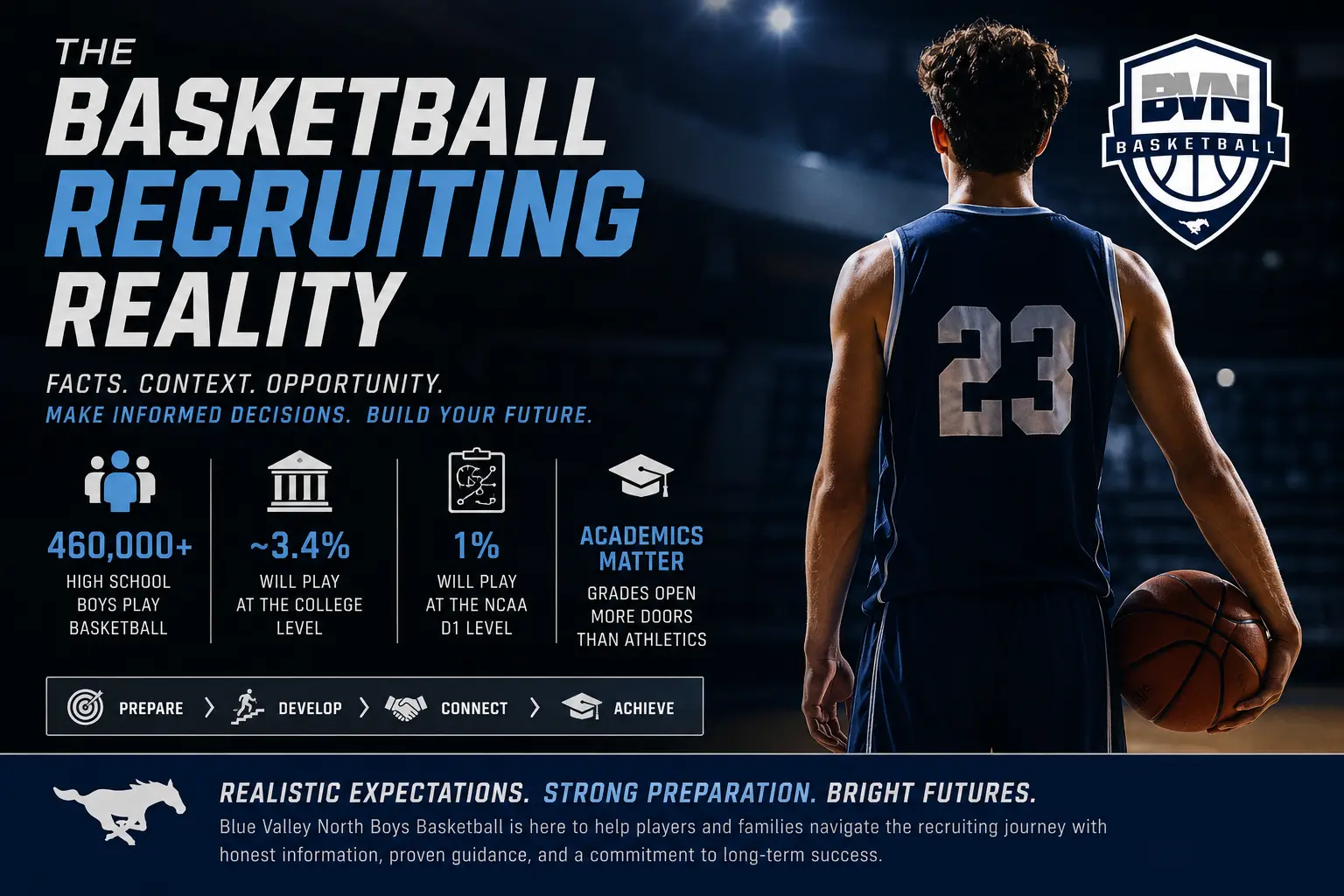
Blue Valley North Boys Basketball

2020-2021 6A State Champions
No college offers junior year basketball recruiting guide

No College Offers Junior Year?

If a basketball player has no college offers by junior year, the first move is not panic. It is diagnosis. No offers can mean the player is at the wrong target level, has weak film, has not contacted enough schools, lacks academic clarity, has a role that is hard to evaluate, or simply has not reached the part of the market where his best opportunities live.

The danger is reacting emotionally: buying every camp invite, chasing schools that never answer, blaming exposure, or assuming the player is either “D1” or “done.” Junior year is late enough to get serious, but not too late to build a smart plan.

This page gives families a practical reset: what no offers actually means, what to fix first, which schools to contact, how to talk to coaches, and when to stop spending money on noise.

The Real Meaning Of “No Offers”

No offers does not always mean no college future. It usually means the recruiting market has not yet given a clear yes. That could be because the player is being evaluated at the wrong level, has not been seen in the right format, has not made contact, or has a profile that needs more context.

The family has to separate five different problems that often get lumped together as “not recruited.”

The No-Offer Diagnosis Matrix

Families often say, “He needs more exposure.” Sometimes that is true. Often it is not. Exposure only helps if the player is exposed to the right schools, with the right film, at the right level, with the right academic and contact information attached.

Possible ProblemWhat It Looks LikeWhat Families Usually Do WrongBetter Move
Wrong LevelOnly contacting D1 schools, no replies, no personalized feedback.Assume silence means coaches have not seen him enough.Add D2, D3, NAIA, JUCO, and selective walk-on targets based on roster comparison.
Weak FilmHighlights are long, slow, mostly layups, no defense, no full-game link.Pay for another event instead of fixing the first evaluation tool.Make a short role-based film and attach a full game with context.
No Role ClarityPlayer is good in high school but film does not show what he will be in college.Describe him as “versatile” without proof.Define the college role: shooter, defender, lead guard, connector, rim runner, stretch forward.
Academic FogEmails do not include GPA, transcript status, test plan, or intended major.Assume basketball interest comes first.Make academics a recruiting asset. Coaches need admissions confidence.
Poor OutreachGeneric email blasts, parent-led communication, no follow-up.Send more generic messages.Send fewer, better emails to schools that fit position, level, academics, and location.
Bad TimingPlayer improved recently but old film, old stats, or no updated schedule are circulating.Wait for coaches to notice.Update the package immediately and send a “new film/new role” message.

Junior year rule: do not spend another dollar until you know which bottleneck you are fixing. A camp fixes visibility. It does not fix bad film, wrong level, unclear role, weak academics, or poor communication.

The Four Types Of Offerless Juniors

The Hidden Fit

Can play somewhere, but the family is only looking too high. Needs a wider list, not panic.

The Late Bloomer

Physical growth or role growth arrived late. Needs updated film and a clear “new version” message.

The Good HS Player

Productive in high school, but college role is unclear. Needs film that shows translation, not just production.

The Under-Communicator

Has ability but no coach contact, no organized list, no schedule sent, and no follow-up system.

The Academic Mismatch

Target schools do not fit transcript, test plan, or admissions profile. Needs academic honesty fast.

The Event Chaser

Has been to events, but nobody is tracking him. Needs targeted outreach, not another wristband.

The plan changes depending on which type the player is. A late bloomer needs current proof. A hidden fit needs better school matching. An event chaser needs fewer events and more direct coach conversations.

Rebuild The Recruiting Board

A recruiting list is not a list of schools a player likes. It is a working board of schools where the player may fit athletically, academically, financially, geographically, and positionally.

Board TierWho Belongs HereHow ManyAction
Reach But ExplainableSchools slightly above current market where the player has one real reason to fit.5-8Send film, but do not build the whole plan around them.
True FitSchools with rosters, level, academics, and location that make sense.12-20Prioritize direct outreach and schedule updates.
Late OpportunityD3, NAIA, JUCO, regional D2, or walk-on options that may recruit later.15-25Send concise messages and ask direct evaluation questions.
Academic/Fit FavoritesSchools the player would attend even if basketball became limited.5-10Research admissions and cost early.

A strong junior-year board has more than logos. It includes current roster needs, graduating players, position depth, admissions fit, total cost, distance from home, and the kind of role the player can realistically earn.

The Film Fix For Offerless Juniors

If a player has no offers, the film must answer the questions coaches are likely asking. More clips are not always better. Better evidence is better.

Coach QuestionFilm Evidence NeededWeak Evidence
What is his college position?Clips that show the player doing college-role actions at game speed.Random scoring plays with no role pattern.
Can he guard?On-ball stops, closeouts, rotations, rebounding contact, communication.Only steals and blocked shots.
Can he think?Quick decisions, extra passes, advantage reads, shot selection.Only one-on-one scoring.
Can he handle physicality?Finishes through contact, box-outs, strong cuts, pressure handling.Open layups against weak defense.
Does he fit our pace?Transition decisions, spacing, early offense, defensive urgency.Slow clips or isolated highlights.

The 2+1 Film Package

  • One short highlight video: 90 seconds to 3 minutes, best role evidence first.
  • One full-game link: preferably against a strong opponent where the player’s role is clear.
  • One context note: graduation year, height, position, GPA, role, coach contact, and upcoming schedule.

Do not make the coach guess. The film package should show who the player is, what role he projects to, and why he is worth a second look.

What To Send Coaches Now

The junior-year no-offer message should not sound desperate. It should sound organized. The point is not “please recruit me.” The point is “here is my current profile; can I fit what you need?”

Initial Junior-Year Reset Email

Coach [Last Name],

My name is [Player Name], a [graduation year] [position] at Blue Valley North High School in Overland Park, Kansas. I am [height], have a [GPA], and I am reaching out because I believe [school name] could be a strong basketball and academic fit.

Current film: [highlight link]
Full game: [full game link]
Schedule: [schedule link]
High school coach contact: [coach name/contact]

I would appreciate honest feedback on whether I fit what your staff is looking for in my class.

Thank you,
[Player Name]

Follow-Up After No Response

Coach [Last Name],

I wanted to follow up with my updated schedule and film. I understand your staff is busy, but if there is a better contact for my position or class year, I would appreciate being pointed in the right direction.

Thank you again,
[Player Name]

Player-led communication matters. Parents can help organize the board, but the player should be the voice. College coaches notice maturity before they ever offer a spot.

Before You Pay For Another Camp

Junior year is when panic spending begins. Families start buying camps and showcases because the silence feels scary. Some events are worth it. Some are expensive motion with no recruiting value.

Before Paying, AskGood AnswerBad Answer
Has the staff seen his film?Yes, and they want to evaluate him live.No, but the invite email sounded personal.
Does this school fit academically?Yes, admissions and major options make sense.We have not checked.
Does the level match?Current roster comparison shows a possible fit.It is a dream school.
What happens after the event?There is a clear follow-up plan.We hope someone notices.

Red flag: the only time a school contacts a player is when there is a paid camp coming up. That does not mean the camp is useless, but it means the family should ask direct questions before paying.

The 30-Day No-Offer Reset Plan

TimeframePlayer ActionParent/Family ActionGoal
Days 1-3Gather film, height, GPA, position, schedule, coach contact.Stop buying events until the diagnosis is clear.Build the recruiting package.
Days 4-7Cut or update highlight film and select one full game.Help identify schools by level, location, academic fit, and cost.Stop relying on old or random clips.
Days 8-14Email the first 15 true-fit schools.Track replies without taking over communication.Start real feedback loops.
Days 15-21Send follow-ups and add late-opportunity schools.Compare cost and admissions realities.Expand beyond dream logos.
Days 22-30Call or email coaches who respond and ask what they need to see next.Only pay for camps that match actual interest or strong fit.Turn silence into information.

At the end of 30 days, the family should know more than they knew at the start. Even silence is data if the list was built correctly.

What Silence From Coaches Means

Silence does not always mean the player is not good. But silence from the right schools after good outreach means something has to change.

Silence From Reach Schools

Not surprising. Keep them on the list, but do not let them control the plan.

Silence From True-Fit Schools

Review film, role clarity, academic info, and whether the level is still too high.

Replies From Lower Levels

Do not dismiss them. The market may be showing where the real opportunity lives.

Market feedback is not personal. It is information. Smart families adjust faster than emotional families.

When No Offers Becomes A Problem

No offers by junior year is manageable. No plan by junior year is the bigger problem. The situation becomes more serious when a player has no current film, no outreach list, no academic clarity, no realistic level comparison, and no willingness to adjust.

Problem sign: the family keeps saying “he just needs the right person to see him” but cannot name the right level, right school type, right college role, or right next step.

Good sign: the player is willing to hear honest feedback, update film, contact realistic schools, improve academically, and judge opportunities by fit instead of ego.

Final Word For Juniors With No Offers

The player with no offers still has power if he gets organized. He can build better film, contact better-fit schools, improve grades, ask direct questions, attend smarter events, and stop confusing attention with opportunity.

The next step is not to panic. The next step is to find the bottleneck and fix it.

Advertisement